
Do all four tyres have to match on a Subaru?
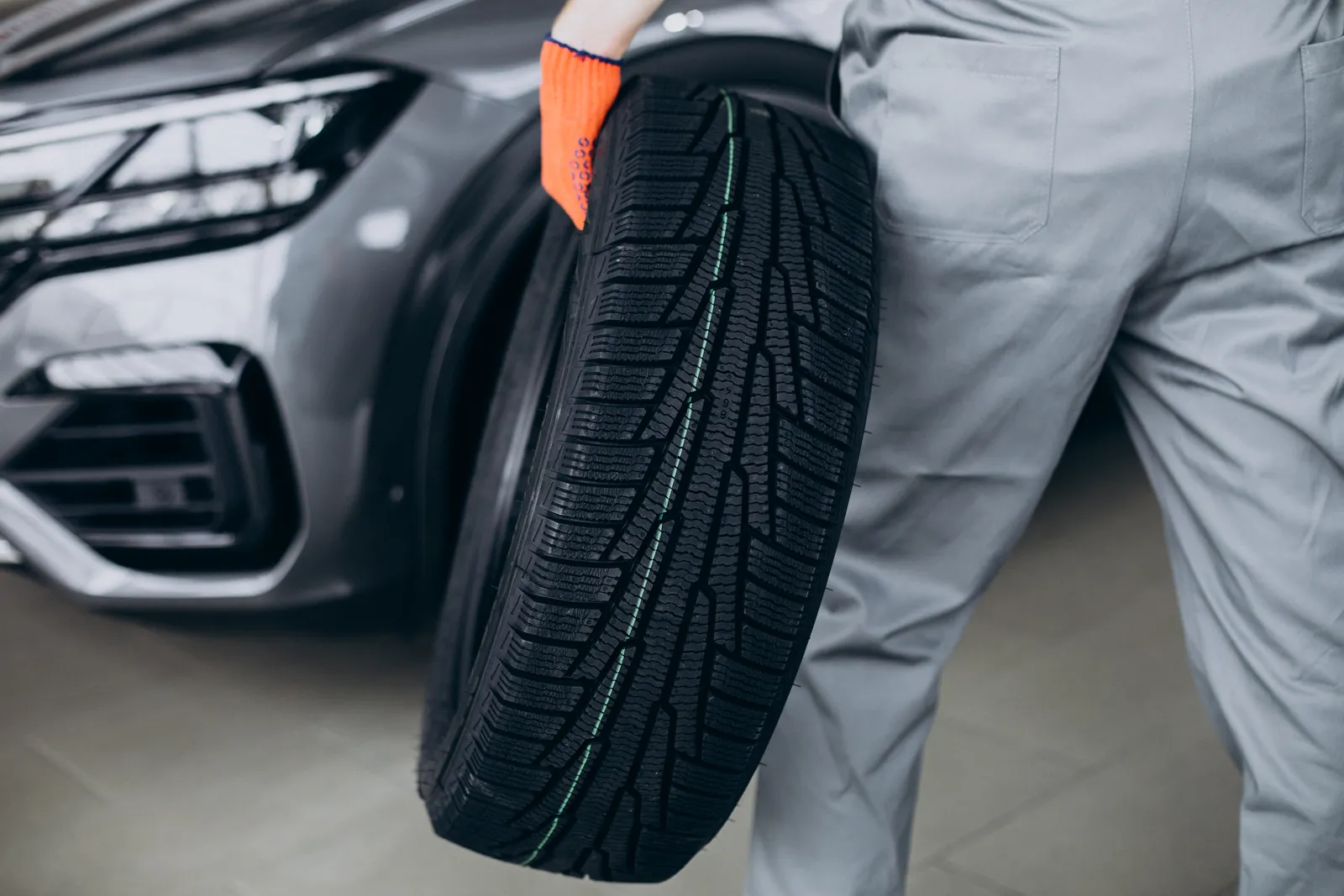
Subaru publishes a 6mm circumference tolerance in its technician literature and no number at all in the owner's manual. Here is what that means when you destroy one tyre.
Published Updated
Subaru's owner's manual says all four tyres must match in eight respects, including circumference and wear, and its technician literature limits the circumference difference to 6mm. That is less than a millimetre of tread, so on a Subaru with a worn set, one new tyre usually means buying four or shaving the new one to match.
- Subaru's technician literature limits the circumference difference between tyres to 6mm, which is not a tread depth figure.
- The 2/32 of an inch rule often quoted online is not a Subaru figure and is about 1.7 times more lenient.
- Two new tyres on one axle creates exactly the front to rear difference the transfer clutch has to absorb.
- A flashing AWD warning light means park and check that all four tyres match and hold their pressure.
- Rotating at every service keeps wear even, which keeps shaving or a matched used tyre a workable option.
You pick up a screw in a sidewall. The tyre is not repairable. The others have maybe forty percent of their life gone. The tyre shop says buy two, a mate says buy four, and something you half remember says a Subaru will eat itself if you get this wrong.
It is a genuinely expensive question and almost everything written about it online is American. So we went and found what Subaru actually publishes.
What does the owner's manual say?
Under tyre replacement, Subaru lists eight things all four tyres must match on: size, speed symbol, load index, circumference, construction, manufacturer, brand and tread pattern, and degree of wear.
"If all four tires are not the same in items (a) to (h), serious mechanical damage could be caused to the drivetrain of the car."
— Subaru owner's manual, tyre replacement
And just before it: for safe vehicle operation, Subaru recommends replacing all four tyres at the same time.
Notice that circumference and degree of wear are stated as absolutes with no tolerance attached. The manual does not tell you how close is close enough. In the European version of the same manual this list sits under a heading about driving tips for all wheel drive vehicles, which tells you exactly why it is there.
What number does Subaru actually publish?
A 6mm limit on the difference in circumference between tyres. It is in the technical newsletter Subaru sends its own technicians, in a December 2021 special edition on transfer clutch diagnostics, and Subaru traces it back to its own December 2010 bulletin.
"The tire circumference difference should be no more than 6mm or ¼" of each other. This measurement is different than tread depth."
— Subaru technician newsletter, transfer clutch system diagnostics, December 2021
The same document tells technicians how to measure it, and it is refreshingly low tech: a cloth tape measure around each tyre, roughly 120 inches long, with every tyre at the pressure on the door placard. A string will do if it does not stretch.
Two Subaru service bulletins repeat the figure. Both state that as little as a quarter of an inch of difference in rolling circumference can cause internal issues, or can cause binding.
Subaru uses 6mm and a quarter of an inch interchangeably, and they are not quite the same number, since a quarter inch is 6.35mm. We work to 6mm because it is the more conservative of the two.
Three numbers you will see online that are wrong
| What you will read | The reality |
|---|---|
| "Within 2/32 of an inch of tread depth" | Not a Subaru figure. It is what some other manufacturers recommend, and Subaru's own document says its specification is different to tread depth. It works out at roughly 10mm of circumference, about 1.7 times more lenient than Subaru's 6mm. |
| "Within a quarter inch of diameter" | A misquote of a real Subaru figure. Subaru says a quarter inch of circumference, not diameter. Quarter of an inch of diameter is about three times more lenient. |
| "Within 10mm" | This comes from a Kia bulletin about the same class of problem, not from Subaru. It reads convincingly like a Subaru document. It is not one. |
Why does it matter more on some Subarus than others?
Almost everything written about this treats Subaru all wheel drive as one thing. It is four things, and they do not behave the same way.
| System | Where you find it | How it handles a mismatch |
|---|---|---|
| Viscous limited slip centre differential | Manual transmission cars | A real centre differential accommodates the speed difference by rotating. The viscous unit resists it and heats up. Failure mode is the silicone fluid slowly cooking. |
| Active torque split, a hydraulic multi plate transfer clutch | Lineartronic CVT models and the older four speed automatics. Nominal 60 front, 40 rear. | There is no centre differential at all. The clutch pack is the coupling, so a permanent speed difference has to be absorbed by slip inside a wet clutch that is being asked to hold torque. |
| Variable torque distribution, a planetary centre differential plus a transfer clutch | WRX CVT, Outback XT, the 3.6 litre models, older five speed automatics. Nominal 45 front, 55 rear. | Has a genuine differential as well as a clutch, so it can absorb a speed difference more readily. |
| Driver controlled centre differential | WRX STI only. Nominal 41 front, 59 rear. | A real, driver adjustable centre differential. The manual itself describes a braking effect with vibration and noise when front and rear rotation differ, and notes it goes away at the minimum lock setting. |
Our read on which is most tolerant, and this is our engineering judgement rather than a Subaru statement, since Subaru publishes no per system tolerance: the two systems with a genuine centre differential cope best, the viscous manual sits in the middle, and the electronically controlled transfer clutch used with the Lineartronic CVT is the least tolerant of the four.
That last point is the one that matters, because almost every Subaru sold in Australia in the last decade is that type. It is also why every Subaru bulletin on this subject is a transfer clutch bulletin.
What actually goes wrong, and how do you know?
The car will usually tell you first. Subaru's own manual is unusually direct about it:
"Continued driving with the AWD warning light flashing can lead to powertrain damage. If the AWD warning light flashes, promptly park in a safe location and then check whether all four tires are the same diameter and whether any of the tires has a puncture or has lost air pressure for some other reason."
— Subaru owner's manual, all wheel drive warning light
The symptoms Subaru names in its service bulletins are a chattering sound or shudder felt when making sharp turns, a binding or juddering sensation when turning, crabbing, and harsh engagement when shifting from reverse to drive. The classic one is reversing into a parking spot on full lock and feeling the driveline fight itself.
What is happening inside is the clutch pack slipping continuously and generating heat it was never meant to shed. When Subaru tells its technicians how to inspect one, it tells them to look for heat marks, burnt spots and missing or patchy friction material, and then to run a fingernail around the inside of the drum looking for scoring. Once the drum is scored, it is replaced.
The honest part: it is gradual, and there is an early stage
Subaru's own diagnostic guidance says that where the clutch plates have only glazed or burnished, a fluid change may be all that is needed to clear the condition. After that it progresses to heat damage in the friction material, then drum scoring, then a full overhaul with the transmission out of the car.
Nobody publishes how many kilometres of mismatch it takes to get from the first stage to the last. Not Subaru, not anyone. Anyone who gives you a number is guessing. What Subaru does say is that even the temporary spare should be used only for the minimum time necessary.
For scale, Subaru's own book time for removing the transmission and overhauling the transfer clutch assembly is 5.4 hours, plus a clutch assembly, a selective thrust bearing, gaskets, seals and fluid.
The arithmetic, which settles the argument
Six millimetres of circumference is a much smaller amount of wear than most people assume. Converting it to tread depth, which is what a tyre shop actually measures, 6mm of circumference is a difference of about 0.95mm of tread. That is roughly 1.2 thirty seconds of an inch.
Which means a tyre can wear less than a millimetre, about fifteen percent of its usable tread, before a brand new tyre alongside it is already outside Subaru's figure. In practice that is a tyre with perhaps eight to fifteen thousand kilometres on it.
Here is what that looks like across a set. Assume a new tyre with 8mm of tread and a legal minimum in Victoria of 1.5mm, so 6.5mm of usable depth.
| Wear on the other three | Tread removed | Circumference gap against a new tyre | Multiple of Subaru's 6mm |
|---|---|---|---|
| 20 percent worn | 1.30mm | 8.2mm | 1.4 times |
| 30 percent worn | 1.95mm | 12.3mm | 2.0 times |
| 40 percent worn | 2.60mm | 16.3mm | 2.7 times |
| 50 percent worn | 3.25mm | 20.4mm | 3.4 times |
| 60 percent worn | 3.90mm | 24.5mm | 4.1 times |
That table is our own conversion from Subaru's circumference figure rather than something Subaru publishes, and loaded rolling circumference differs slightly from the free circumference you measure with a tape. Treat it as indicative. The conclusion holds at any reasonable set of assumptions.
So what do you actually do?
Usually buy four, or have one new tyre shaved to match if the other three are less than about half worn. Four options, honestly ranked for a set that is around forty percent worn.
- Buy four. The only option that is unambiguously inside Subaru's figure. The downside nobody mentions is that you throw away most of the remaining life of three tyres you already paid for. It is still usually the right answer, and note that most retailers price a set of four well below four times the single tyre price, which narrows the gap against buying two considerably.
- Buy one and have it shaved. Technically the correct engineering answer and the cheapest compliant one, if you can get it done, if the same tyre is still made, and if the shave can hit the target. It voids the new tyre's tread wear warranty. It stops making sense once the other three are more than about half worn, which is why forty percent is right at the edge.
- Buy two for the same axle. This is the standard advice for a front wheel drive car and it is the wrong answer here. It leaves a deliberate difference of around 16mm between the front pair and the rear pair, which is precisely the axis the centre differential or transfer clutch has to absorb. Two new tyres on one axle is arguably worse for the driveline than one new tyre.
- Fit one new tyre and rotate. Not a fix. Rotation moves the mismatch around the car, it does not reduce it. The front to rear difference exists in every rotation position.
There is a fifth option worth raising because it is legitimate and cheap: a good second hand tyre of the same model with matching wear, measured with a tape to Subaru's own method. If the casing is sound, it is a perfectly sensible answer.
On tyre and rim insurance
If you have a tyre and rim policy, read what it actually covers before you assume it will fund a set. The standard structure in Australia is that the insurer repairs or replaces the damaged tyre, and everything else is expressly excluded as consequential loss.
A line about replacing "no more than four tyres" during the period of insurance is a lifetime cap on the policy, not a promise to replace a set. Most policies also exclude a tyre already worn below the tread wear indicator.
Tyre shaving
A machine cuts rubber off the tread of a new tyre so that its diameter matches the worn tyres already on the car. It is the neatest solution to this problem and it is common enough overseas that published costs sit around twenty five to thirty five dollars a tyre.
In Australia it is harder to find, because the machines here are mostly used for motorsport rather than tread matching. There is a business in Kilsyth, about six kilometres from us, that offers tyre buffing.
The rule of thumb worth publishing either way: shaving makes sense only when the existing tyres are no more than about half worn. Below that you are shaving away most of a new tyre's life to save the price of one tyre.
The spare, which is its own problem
Subaru has been one of the last manufacturers still fitting a full size spare, and on an all wheel drive car that is not a nicety, it is the correct engineering answer. The 2026 Outback and the petrol Forester both have one. The Forester Hybrid has a tyre repair kit instead, which on an all wheel drive car is a materially worse substitute than it is on a front wheel drive one, because a sealant kit cannot get you out of a sidewall cut.
If your Subaru carries a temporary space saver, Subaru's own rules for it are strict, and they exist because of everything above:
- Never use any temporary spare other than the original one. Using another size may cause severe mechanical damage to the drivetrain.
- Do not exceed 80 kilometres per hour.
- It must be fitted to a rear wheel. If a front tyre goes, move a rear wheel to the front and put the temporary spare on the back.
- Do not use two of them at once, do not fit chains to one, and never tow with one fitted.
- Inflate it to 60 psi, which is far higher than a normal tyre and is routinely forgotten.
- Replace it with a conventional tyre as soon as possible. Subaru notes that the all wheel drive warning light may flash while it is fitted, and that use should be restricted to the minimum time necessary.
One thing worth clearing up: Subaru publishes no maximum distance for the temporary spare, only a maximum speed. The 200 kilometre figure you will see quoted belongs to the tyre sealant repair kit, which is a different item with its own separate rules.
How do you avoid this problem?
Rotation. It is on Subaru Australia's maintenance schedule as "rotate wheels front and rear as necessary", marked as a performed item at every service from A through H, which means it is included in capped price servicing. The loophole is the phrase "as necessary", and it is the sort of thing that quietly gets skipped.
Rotating keeps all four tyres within a few tenths of a millimetre of each other for their whole life. That does two things. You never develop a front to rear difference in the first place. And when one tyre does get destroyed, the other three are worn evenly, so shaving or a matched used tyre is still a workable option. A car that has never been rotated, with 3mm on the front and 6mm on the back, has no cheap option at all.
On a Subaru, rotation is not just tyre life maintenance. It is driveline insurance.
The other half of it is alignment. These cars have independent rear suspension with adjustable rear toe, so a front only alignment cannot correct the rear. Rear misalignment scrubs the rear tyres at a different rate from the fronts, which creates the very mismatch this article is about. That is our view rather than a Subaru requirement, and Subaru's own position is that alignment frequency depends on how the car is driven.
What we do about it
If you are staring at one destroyed tyre, bring the car in before you buy anything. We will measure the circumference of all four with a tape at placard pressure, which is Subaru's own method, and tell you exactly where you sit against the 6mm figure. Then you can decide between one, two, four or a shave with an actual number in front of you instead of an opinion from behind a counter.
That check is free. A transfer clutch is not.
Free tyre circumference and tread check.
Subaru specialists for WRX, STI, Forester, Outback, Liberty, Impreza, XV and BRZ. If your all wheel drive warning light is flashing, or the car binds on full lock, do not keep driving it. Bring it to us via a free initial diagnostic. For rotation at every service, see our logbook servicing.
- TechTIPS Special Edition: Transfer Clutch System Diagnostics, Subaru of America, via NHTSA
- 12 Month/12,500 Kilometre Service Interval Warranty and Service Handbook (SA1196), Subaru Australia
- 12 Month/15,000 Kilometre Service Interval Warranty and Service Handbook (SA1197), Subaru Australia
Also consulted
- Subaru owner's manual, tyre replacement and all wheel drive warning light sections, United States and European editions
- Subaru service bulletin on all wheel drive transfer clutch chatter and shudder, March 2019
- Subaru technician newsletter, April 2021, binding when turning diagnosis
- Subaru service bulletins on vibration and judder on turns, and on the multi plate transfer clutch warranty extension
- Subaru 2022 WRX accessory guide, viscous and variable torque distribution descriptions
- Transport Victoria, tyre maintenance and repair, VSI 16, for the 1.5mm legal minimum tread depth
- Volkswagen motor vehicle tyre and wheel insurance product disclosure statement
- CarExpert and Chasing Cars, 2026 Subaru Outback and Forester reviews, for spare wheel fitment
- JAX Tyres published pricing in common Subaru sizes, retrieved September 2026
- Tire Rack and Consumer Reports, for tyre shaving cost and the half worn rule of thumb
Common questions
- Can I replace just one tyre on a Subaru?
- Only if the other three are barely worn, or if the new tyre is shaved to match. A tyre passes Subaru's 6mm circumference figure after roughly fifteen percent of its usable tread is gone, as little as eight to fifteen thousand kilometres. At forty percent worn, a single new tyre is about 2.7 times outside the figure.
- Is it OK to replace two tyres on a Subaru?
- Replacing two on the same axle is the usual advice for a front wheel drive car and it is the wrong answer for an all wheel drive Subaru. It creates a deliberate difference between the front pair and the rear pair, which is exactly the difference the centre differential or transfer clutch has to absorb.
- What tread depth difference is acceptable on a Subaru?
- Subaru specifies circumference rather than tread depth, and says so explicitly. Its 6mm circumference figure works out at roughly 0.95mm of tread depth, or about 1.2 thirty seconds of an inch. The commonly quoted 2/32 of an inch rule is not a Subaru figure and is roughly 1.7 times more lenient.
- What happens if you run mismatched tyres on a Subaru?
- The transfer clutch on most modern Subarus slips continuously and overheats, glazing then burning the friction material and eventually scoring the drum. Symptoms are shudder on sharp turns, binding when turning, harsh reverse to drive engagement and a flashing all wheel drive warning light. Subaru's book time to remove the transmission and overhaul the transfer clutch is 5.4 hours.
- How often should Subaru tyres be rotated?
- Rotation appears on Subaru Australia's maintenance schedule as a performed item at every service, so at every 12,500km or 15,000km service depending on your model. It is included in capped price servicing. Rotating is the cheapest thing you can do to avoid this problem entirely.