
Subaru suspension: what wears out, what it sounds like, and what it costs
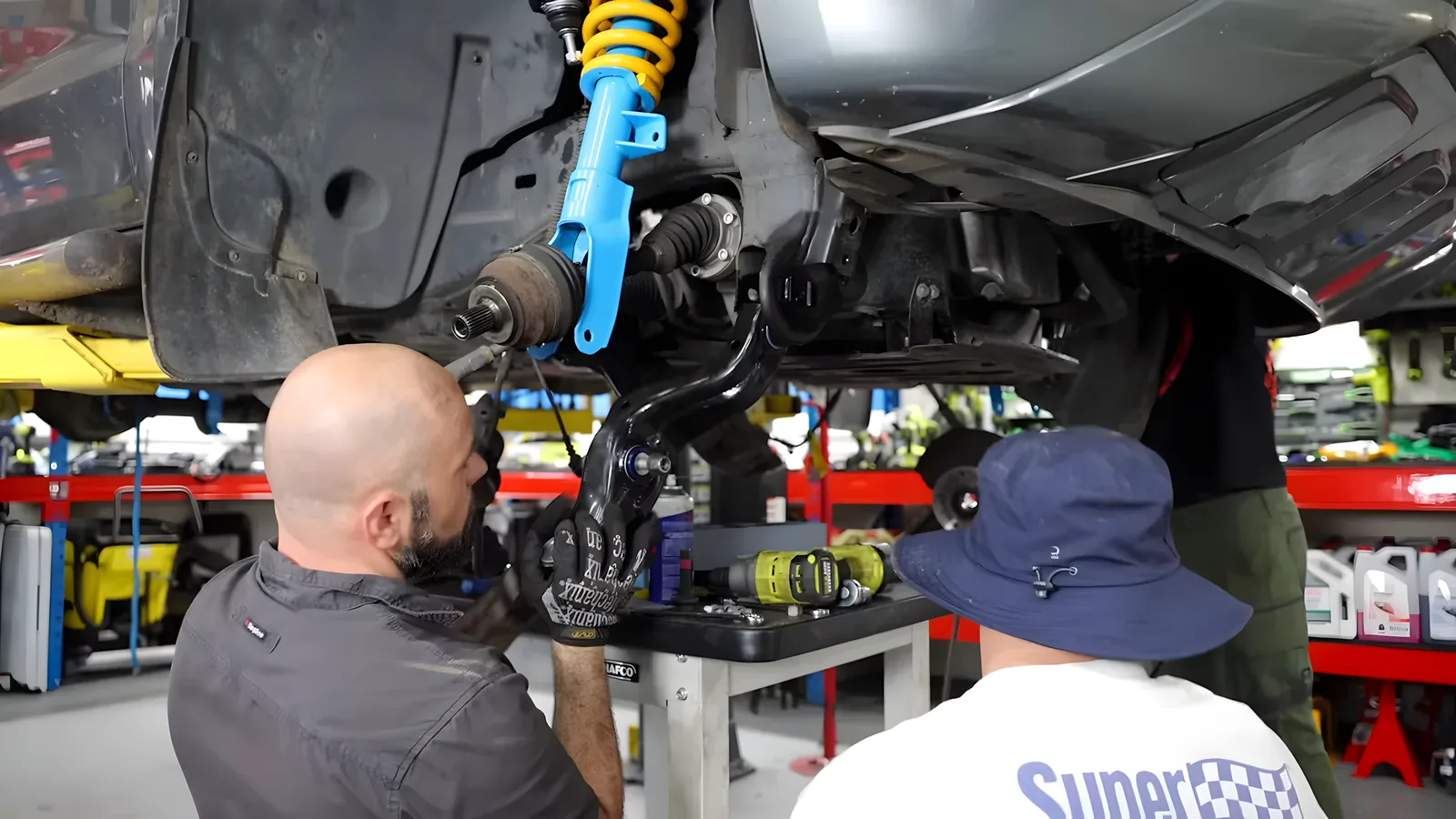
A clunk over speed humps, inner edge tyre wear, a floating ride. What each symptom means on a Subaru, why rear camber cannot be adjusted, and what the work costs.
Published
Struts and shocks are the headline item, but they are rarely the first thing to go. Bushes, strut top mounts and sway bar links usually get there first, and they are the ones making the noise. The Subaru specific part is the rear end.
- Bushes, strut top mounts and sway bar links usually wear before the struts and shocks, and they are the parts making the noise.
- Rear toe is adjustable on these Subarus but rear camber is not, so worn rear link bushes have to be replaced rather than aligned out.
- A proper Subaru alignment covers all four corners and finishes with the steering angle sensor recalibrated.
- Replace strut top mounts, bearings, bump stops and boots with the struts, or you pay the labour twice.
Most suspension work starts with a noise. A knock over a speed hump that was not there last month. A creak pulling into a car park. Or it starts with a tyre fitter pointing at the inside edge of a rear tyre that is bald while the rest of it looks fine.
Here is what each of those actually means on a Subaru, and why the answer is a bit different on these cars than on most.
The short answer
Struts and shocks are the headline item, but they are rarely the first thing to go. Bushes, strut top mounts and sway bar links usually get there first, and they are the ones making the noise.
The Subaru specific part is the rear end. These cars have independent rear suspension where rear toe is adjustable and rear camber is not. That means worn rear link bushes cannot be dialled out with an alignment. They have to be replaced.
And because Subaru publishes one of the tightest tyre matching tolerances in the industry, suspension wear on an all wheel drive Subaru is not only a comfort and tyre question. It is the thing that quietly walks the car outside its own tyre spec.
What actually wears
Struts and shock absorbers
No manufacturer publishes a kilometre life, and anyone who gives you one is making it up. The useful reference points: Monroe Australia recommends inspection every 20,000 km and offers a three year or 60,000 km warranty on many units as a benchmark, and KYB notes that by around 80,000 km suspension components have gradually worn down.
The reason to care is not ride comfort. Monroe publishes two figures worth knowing: at 50 km/h, one worn shock absorber can increase stopping distance by up to two metres, and worn shocks can add as much as 20 per cent to stopping distance. Those are Monroe's numbers rather than an independent study, but the mechanism is not controversial. A damper that cannot control the spring lets the tyre leave the road.
Strut top mounts and bearings
This is the one most people have never heard of and the one that most often makes the noise. The mount carries the top of the strut and, on the front, includes a bearing the whole strut turns on when you steer.
KYB is unambiguous: if a strut has failed it is highly likely the strut mount, dust boot and bump stop are worn out as well, and mounts and bearings should be replaced with every strut change. Their strut kit comes with all of it in one box for exactly that reason. Subaru itself, in a bulletin about a knocking noise over bumps at low speed, instructs technicians to investigate the strut mounts next if the noise persists. Replacing struts and reusing tired mounts, bearings, bump stops and boots is a false economy, and you pay the labour twice.
Control arm and rear link bushes
This is where the Subaru detail matters. Alignment trade guidance on the Forester and Legacy is clear on three points: rear camber is not adjustable, the lower longitudinal link is not adjustable, and rear toe is adjustable with an inboard cam bolt.
The consequence is the useful bit. Worn link bushings cause negative camber and toe, which leads to inner edge tyre wear, and because rear camber has no adjustment, that wear cannot be corrected on the alignment rack. It is a parts job. An alignment afterwards stops it getting worse. It does not undo it.
Worth knowing too that a cracked bush does not always affect how the car drives, so a visual crack is not automatically a verdict. A deflection check under load is the better test.
Sway bar links and bushes
The end links and bushes wear far more often than the bar itself. Symptoms are clunking from around the wheels, loose steering, and noise or reduced control when cornering. These are cheap parts, and leaving them produces uneven tyre wear that costs more to fix than the links did.
Wheel bearings
A normal wear item with an Australian accelerant: water and dirt get in, the lubricant breaks down, and gravel road driving wears them faster. If you do the Dandenongs and the gravel beyond them, assume a shorter life than the brochure case.
Springs and ride height
Springs sag. On older Foresters and Outbacks a car that sits lower than it used to is usually springs, though a collapsed upper strut mount or a bent strut shaft can do the same thing, so it gets checked rather than assumed.
One trap worth flagging if you are buying springs for a wagon: some Outback and Forester models have self levelling rear suspension, and a spring maker's own catalogue warns that if it is fitted, a shock absorber for non self levelling suspension must be fitted along with the spring. Fitting the spring alone gets you a car that rides badly and an owner who cannot work out why.
In Victoria, restoring sagged springs to the original ride height is maintenance, not a modification. That is worth knowing before anyone tells you it needs engineering.
Symptoms, and what they usually mean
| What you notice | Usual suspect |
|---|---|
| Clunk over speed humps, movement you can feel through the car | Strut top mount |
| Knocking on turn in, clunk near the wheels, steering feels loose | Sway bar links |
| Nose dives hard under brakes, car swerves a little when stopping | Front struts or shocks |
| Floating or wallowing, rocking on after a bump, sway through corners | Shocks |
| Wandering on the freeway, pushed around by crosswinds | Shocks, or rear thrust angle |
| Inner edge of a rear tyre worn out, rest of the tread fine | Worn rear link bushes causing negative camber and toe, which cannot be corrected by alignment |
| Feathered tread, smooth one way and sharp the other | Excess toe, tread scrubbing sideways |
| Outer edge wear, or inner edge wear across both tyres on an axle | Excess positive or negative camber |
| Uneven wear with bald patches | Shocks |
| Vibration that changes with speed | Check steering backlash, tie rod ends, wheel bearings, ball joints and bushes before blaming balance |
| One corner sitting low, knock as the suspension moves | Spring, or a collapsed upper mount or bent strut shaft |
| Uneven ride height side to side | Do not drive it. Steering and braking may be compromised |
About the bounce test
You will be told to push down on a corner and count the rebounds. It is not useless, but it is much weaker than its reputation. It can show a grossly dead damper. It cannot detect one that has lost half its control, and it tells you nothing at all about mounts, bushes or springs, which is where most Subaru suspension noise actually comes from.
Monroe's own advice is a workshop inspection and a road test by a technician, which is a fair thing for a damper manufacturer to say and also happens to be right. We would rather drive it than bounce it.
Why this matters more on a Subaru
On a front wheel drive car, worn suspension costs you tyres and ride quality. On a symmetrical all wheel drive car there is a second consequence, and it is worth understanding properly rather than being scared with.
Subaru publishes an unusually tight tyre matching requirement. Alignment guidance for these cars sets it as a precondition before the car even goes on the rack: all four tyres matching brand and model, wear even, circumference varying by no more than about a quarter of an inch, and tread depth within about 2/32 of an inch. That is among the tightest tolerances any manufacturer specifies, and the reason it exists is the driveline. A permanent front to rear speed difference has to be absorbed somewhere, and on most modern Subarus that somewhere is a clutch pack.
Now put the two things together. Worn rear link bushes produce rear camber and toe you cannot correct. That wears the rear tyres at a different rate from the fronts. Do that for long enough and the car is outside its own tyre matching spec without anyone having fitted a mismatched tyre.
Being accurate about this
Each link in that chain is well supported on its own. Worn bushes cause misalignment. Misalignment wears tyres unevenly. Subaru sets a tight circumference tolerance because of the driveline.
What we have not seen, and will not claim, is a published study joining them end to end into a documented failure pathway. Treat it as the reason the tolerance exists and a good reason not to ignore a worn bush, rather than as a prediction about your transmission.
What a proper Subaru alignment involves
There is a real difference between a Subaru alignment and a cheap front toe adjustment, and it is not sales talk.
- Tyres first. Matching brand and model, even wear, circumference within about a quarter inch, tread within about 2/32. If the car fails that, the alignment is being set around a problem rather than fixing one.
- Ride height measured before anything else. Alignment angles change with ride height. A sagged spring makes every reading meaningless.
- Then camber, then toe, in that order. Subaru advises a sequential process to avoid the angles interfering with each other, and toe is set last because it is the most critical and the most easily disturbed.
- All four corners, not two. Rear toe is adjustable on these cars and thrust angle is set by it. A front only alignment cannot touch either. On an all wheel drive Subaru the correct adjustment is both rear toe bolts turned equally in the same direction.
- Steering angle sensor calibrated afterwards. Change toe or thrust angle and the sensor needs recalibrating with a scan tool.
- EyeSight considered. Alignment and the replacement or repair of suspension components are both listed among the situations requiring EyeSight calibration. That is not only a lift kit issue. It applies to ordinary strut work.
Subaru Australia does not put alignment in the scheduled maintenance at all. It appears in the owner responsibilities as an item for which a charge may be made, with the note that the frequency of these services depends on driving conditions. So nobody is going to tell you when it is due. Published advice ranges from every 10,000 km for maximum tyre life to around 30,000 km or 30 months, with shorter intervals on rough roads.
The non negotiable triggers are simpler: after you hit something, after any abnormal wear pattern appears, and after replacing any major suspension or steering component including wheel bearings, racks and most bushes.
What it costs
Published Australian figures, with one warning attached. A lot of the suspension pricing on comparison sites is template content: the same front shock range appears on every Subaru model page and on cars from other brands entirely. We have left those out. These are the ones that vary properly by job and look real.
| Job | Published Australian range |
|---|---|
| Wheel bearing, Forester | $290 to $475 and up |
| Rear shock absorber, Forester | $300 to $600 |
| Sway bar replacement, Forester | $250 to $800 |
| Sway bar links, pair | about $100 to $300 |
| Strut top mount | $110 to $320 |
| Suspension spring | from about $250 each, more on some applications |
| Suspension bush, depending on location | $100 to $350 and up |
| Four wheel alignment | about $89 to $150, more for 4WD, SUV and performance |
What we charge at Baywrex
Shocks and struts: from $300. · Four wheel alignment: $89 to $150.
Those sit inside the published national ranges above, and that is deliberate rather than accidental. We are not cheaper than the market on routine suspension work. What we are is specific about what the job includes, which on these cars is where the money is actually won or lost.
The alignment range moves with the car: a standard Impreza at one end, a lifted Forester or a performance car needing the full four corner geometry and a steering angle sensor recalibration at the other. The shock range moves with the model and with whether the top mounts and bump stops go in at the same time, which on a car past 150,000 km they usually should, because doing them later means the same strut out again.
From $300 is where a straightforward rear shock starts. A front strut is a bigger job on the same car, because the spring, the top mount and the bearing are part of the assembly and the alignment afterwards is part of the job rather than an extra. We quote the whole corner, not the part.
What moves the number, and what we will not quote blind
A starting figure is only useful if you know what pushes it up, so here is the honest version.
- What moves a strut job above that starting figure. A front strut is not one part. It is the damper, the spring, the top mount and the top mount bearing, and on a car with any kilometres on it the mount and bearing should go in at the same time or the strut comes out again inside a year. Add the alignment and the four corner geometry check, and how far above $300 you land depends almost entirely on how much of the assembly is worth reusing.
- Control arm and link bushes. Published Australian bush pricing runs from about $100 to $350 and up per location, and the spread is almost entirely labour. Some bushes press out in minutes. Others are in a subframe that has to come down. Until the car is on the hoist, nobody can tell you which one you have.
- A full front and rear overhaul. We quote this as one job after inspection, and the reason is that almost nobody actually needs every item on the list. Pricing it as a package before looking means either overcharging the car that needed four things or underquoting the car that needed eleven.
What we will not do is give you a number over the phone and then revise it upward once the wheels are off.
Replacement parts, and when an upgrade is worth it
KYB and Monroe both have Australian operations and both are the sensible default for a like for like replacement. King Springs is Australian and catalogues Subaru applications by generation in lowered, standard and raised heights. Whiteline and SuperPro are Australian and make Subaru specific bush kits, including offset and caster correction bushes, which is directly relevant to everything above: those exist specifically to restore geometry that worn rubber has given away.
An upgrade is worth it when the car's job has changed. If you tow, carry weight regularly, or load the car for touring, heavier rate springs and matched dampers are a real improvement. If the car is normally unloaded, heavy duty parts make it ride badly for no benefit, and the honest advice is standard duty. That is also what the manufacturers' own load guidance says, which is a refreshing thing to be able to quote.
What we would not do is sell you coilovers because a bush is knocking.
Lifting a Forester or Outback, briefly
Victoria's guide to modifications allows suspension to be raised by up to 50mm provided sufficient travel is retained, and allows a combination of suspension lift and larger diameter tyres totalling up to 75mm without the certification otherwise required above 50mm. That 75mm path only works with a commercially available kit, specifically designed and tested for your make, model and variant, fitted to the manufacturer's instructions, and you must keep a written statement of the kit's suitability.
The open question, and we are not going to pretend otherwise, is that the tyre provision is written for an off road type 4WD, and whether a Forester or Outback qualifies under that definition is genuinely unresolved. The national code adds a wrinkle by excluding all wheel drive vehicles from the off road tyre category even where they carry the relevant category rating. Talk to a VASS signatory about your specific car and its compliance plate before you buy a kit, and tell your insurer.
Three practical effects worth knowing regardless. Lifting changes CV joint angles, and the issue is sustained angle under load rather than lift height by itself, so a joint can look fine parked and bind at full lock or full droop. EyeSight references a known camera height and static rake, so a lift changes what it is measuring against. And alignment, front and rear, is part of the job, not an afterthought.
What we do
Our suspension check is free, and here is exactly what it is: on the hoist, every bush and joint checked for play under load, mounts and bearings checked, ride height measured at all four corners, tyre wear patterns read, and a road test. Then we tell you what is actually worn and what is fine, and in what order it needs doing.
Not everything that is worn needs doing today. We would rather tell you which two things matter and which three can wait than hand you a list.
Free suspension and alignment check
Baywrex, Tower 2 / 591 Dorset Road, Bayswater North VIC 3153. Call 0410 164 954 or book online.
Subaru specialists. Struts, bushes, mounts, bearings and four wheel alignment for WRX, STI, Forester, Outback, Liberty, Impreza, XV and BRZ.
- Shock Absorber Safety, Monroe Australia
- Safety Triangle, Monroe Australia
- Knocking-Type Sound from Engine Compartment, bulletin 05-74-20, Subaru of America, hosted by NHTSA
Also consulted
- KYB Australia, strut kit guidance on replacing mounts, bearings, bump stops and boots with struts, kyb.com.au
- Subaru service bulletins on strut mount investigation for a low speed knock, and on rear suspension noise, hosted by NHTSA and CarComplaints
- Alignment trade guidance on 2009 to 2013 Forester and 2005 to 2009 Legacy, including rear camber not adjustable, rear toe cam bolt adjustment and the camber then toe sequence
- Subaru suspension and wheel alignment technical reference, including thrust angle definition and the all wheel drive rear toe adjustment method
- Subaru Australia, 5 Year 75,000km Service Plan terms and conditions, which exclude wheel alignment, wheel balancing and suspension components, and the warranty and service book wording on items for which a charge may be made
- AutoGuru published Australian repair costs for wheel bearing, rear shock absorber, sway bar, link rods, strut top mount, springs and bushes, retrieved October 2026
- mycar and Yellow Pages Australia for wheel alignment pricing
- King Springs Subaru catalogue, including the self levelling rear suspension warning. Whiteline and SuperPro Subaru bush and caster correction listings
- Transport Victoria, VSI 8 Guide to Modification for Motor Vehicles, for the 50mm and 75mm provisions and the commercially available kit conditions. VSB14 NCOP11 Section LS on tyre diameter and the all wheel drive exclusion
- Crawford Performance and Whiteline on CV joint angle after a lift, and Whiteline Australia on EyeSight calibration. Both are lift kit suppliers
Common questions
- What is the clunk over bumps on my Subaru?
- The two most common answers are a worn strut top mount and worn sway bar links. A mount usually gives a dull knock with movement you can feel through the car, and sway bar links usually knock on turn in and near the wheels. Subaru's own guidance on a low speed knock over bumps is to investigate the strut mounts. Both are relatively inexpensive parts, and both get worse if left.
- Why is the inside edge of my rear tyre worn out?
- On a Subaru that usually means worn rear link bushes, which produce negative camber and toe. The important part is that rear camber is not adjustable on these cars, so it cannot be corrected on the alignment rack. The bushes have to be replaced, and then the car gets aligned.
- How often does a Subaru need a wheel alignment?
- Subaru Australia does not include alignment in the scheduled maintenance. It is listed as an item for which a charge may be made, with frequency depending on driving conditions. Published advice ranges from every 10,000 km to around 30,000 km. The firm triggers are after hitting something, after any uneven tyre wear appears, and after replacing any suspension or steering component.
- Do I need a four wheel alignment on a Subaru?
- Yes, for anything beyond a basic toe adjustment. Rear toe is adjustable on these cars and it sets the thrust angle, which a front only alignment cannot touch. On an all wheel drive Subaru the rear is adjusted by turning both rear toe bolts equally. The steering angle sensor then needs recalibrating.
- How long do Subaru struts last?
- There is no published figure from Subaru or anyone else. Monroe recommends inspection every 20,000 km, and KYB notes that by around 80,000 km suspension components have worn. Condition depends far more on roads than on kilometres. Monroe publishes that a single worn shock can add up to two metres to stopping distance at 50 km/h, which is the reason it is worth checking rather than guessing.
- Should I replace the strut mounts when I replace the struts?
- Yes. KYB states that if a strut has failed the mount, bearing, dust boot and bump stop are highly likely worn too, and sells them as one kit for that reason. Reusing them means paying the same labour again when they fail.